Waiting for a child to talk is hard, and it’s harder when everyone around you disagrees. One relative says give it time. Another mentions a cousin who didn’t speak until three and turned out fine. Someone else suggests it’s the two languages. None of that tells you what to do this month.
Two languages don’t delay the start of talking
This one is worth clearing up before anything else, because it changes what you do next. Learning two languages does not make a child start talking later. ASHA states it plainly in its own milestone guidance: learning multiple languages will not cause speech or language problems. The American Academy of Pediatrics says the same, that speech and language problems are not caused by learning multiple languages.
So bilingualism isn’t a reason to wait, and it isn’t an explanation for a child who isn’t talking. If something’s going on, the two languages didn’t cause it.
First, what does “not talking” actually mean?
The phrase covers very different situations, and the differences matter more than the label does. Is your child completely quiet, or babbling with plenty of sound but no clear words? Do they have a handful of words that come and go? Do they get their meaning across through pointing, pulling you towards things and showing you objects, just without speech?
A child who babbles, points, brings you things and understands what you say is in a different position from one who is quiet, doesn’t point and doesn’t follow familiar routines. Both are worth taking seriously. They aren’t the same picture.
Count every language
Your child’s words are spread across the languages they hear. Hoff and Core, and Byers-Heinlein and Lew-Williams, both make the same point: a vocabulary that looks small in one language often isn’t small once you count everything. If your daughter says “مَيّ” for water and “ball” in English, that’s two words, not one word and a gap.
Consistent approximations count too. If “ba” always means ball and “da” always means the dog, those are words being used with meaning, even if they don’t sound finished. A child doesn’t need to say a word in both languages for it to count.
This is why the picture from nursery alone, or a single appointment in English, can mislead. Keep a running list of every word, sound and approximation your child uses in each language, and what it means. It takes minutes a week and it’s the most useful thing you can bring to an appointment.
Milestones are reference points, not cut-offs
The CDC’s milestones describe what at least 75% of children can do by a given age. They’re monitoring tools meant to start a conversation, not diagnostic criteria, and the CDC says so directly. ASHA describes its own milestones the same way. Missing one isn’t a diagnosis. It’s a prompt to ask.
For a bilingual child, words in any language count towards these.
- Around 12 months: waves bye-bye, calls a parent “mama” or “dada” or another special name, pauses or stops when you say no.
- Around 15 months: tries one or two words beyond “mama” or “dada”, points to ask for something or to get help, follows a direction given with both words and a gesture.
- Around 18 months: tries three or more words beyond “mama” or “dada”, and follows a one-step direction without needing a gesture, like giving you the toy when you ask.
- Around 2 years: puts at least two words together, such as “more milk”, and points to things in a book when you ask.
- Around 30 months: uses about 50 words and combines words more regularly, including an action word, such as “doggie run”.
Look at more than words
Talking is the visible part of communication, and it arrives after a lot of other things. Notice whether your child points at what they want, looks between you and the object, brings things to show you, copies your actions, responds to their name and takes turns in a back-and-forth game.
Understanding matters just as much. Does your child follow familiar routines, recognise names of people and objects, and respond to simple instructions in whichever language they know best? ASHA notes comprehension is one of the better predictors of how a late-talking child goes on to do. Strong understanding and plenty of gestures are encouraging, though they don’t rule out a difficulty on their own.
About “wait and see”
Some children start talking late and catch up without help. ASHA puts it at roughly 50% to 70% of children with late language emergence, which also means a substantial minority don’t. The honest problem is that waiting doesn’t tell you which group your child is in. Understanding, vocabulary size and family circumstances are the best predictors we have, and none is decisive.
What makes “wait and see” worse is when it’s offered because a child is bilingual. ASHA’s guidance on late language emergence is explicit that becoming monolingual is not necessary and should not be advised as a response. If someone has told you to drop Arabic and see what happens, that isn’t treatment.
What helps at home
Keep speaking whichever language you can be most natural in. ASHA’s advice is to talk to your child in the languages you’re most comfortable using, and give them plenty of chances to hear and practise them daily.
- Follow what your child is interested in and comment on it in short phrases: “car going”, “big ball”, “بدك ميّ”.
- Repeat what they offer and add one piece. If they point at the water, say “you want water”, or the natural equivalent at home.
- Offer real choices, like “apple or banana?”, and accept a look, a point, a sound or a word as the answer.
- Pause after you speak. Give several seconds before repeating yourself.
- Share books by talking about the pictures rather than asking “what’s this?” over and over.
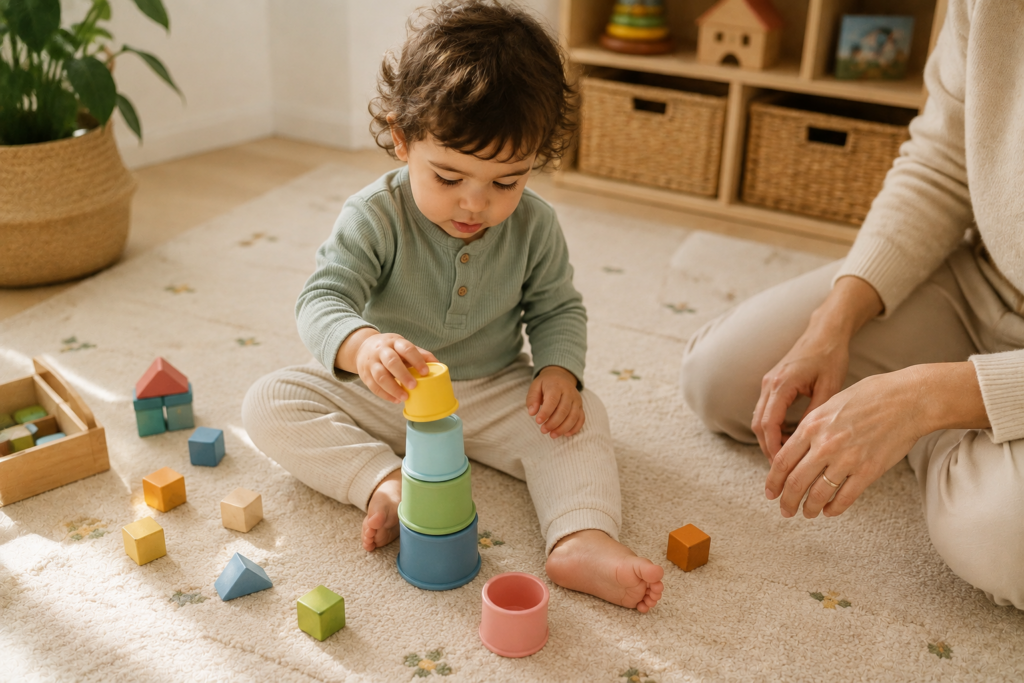
- Use songs, routines and repetitive games, which give your child a predictable slot to join in.
- Don’t make them say a word before handing something over, and don’t correct every attempt.
- Ask nursery staff what your child understands and communicates with them.
When to ask for advice
- Your child has lost words, gestures or social skills they previously had. Ask promptly rather than waiting.
- By around 12 months, no babbling, no gestures like pointing or waving, or no consistent response to sounds and familiar voices.
- By around 15 to 18 months, no attempts at meaningful words in any language.
- By around 2 years, no word combinations in any language.
- They seem to struggle to understand familiar words or simple instructions in their strongest language.
- They rarely point, show you things, copy you or try to get your attention.
- Little change over several months.
- Frustration, or difficulty joining in at home or nursery.
- Any concern about hearing, frequent ear infections, or inconsistent responses to sound.
- You’re worried, even with no milestone clearly missed.
Speak to your child’s doctor and ask about a hearing check. The Hanen Centre recommends having hearing tested even when it seems fine.
Ask for an assessment that looks at communication across all your child’s languages, not just English. An assessment isn’t a diagnosis waiting to happen. Most often it gives you a clearer picture, and if support turns out to be useful, it can start sooner.
Sources
- Centers for Disease Control and Prevention. Learn the Signs. Act Early. Developmental milestones. https://www.cdc.gov/act-early/milestones/index.html (see 1 year, 15 months, 18 months, 2 years, 30 months). Milestones describe what 75% or more of children can do by a given age and are not a substitute for validated developmental screening.
- American Speech-Language-Hearing Association. Communication milestones: birth to 5 years. https://www.asha.org/public/developmental-milestones/ (including 13 to 18 months and 19 to 24 months), which state: “Talk to your child in the languages you are most comfortable using… Learning multiple languages will not cause speech or language problems.”
- American Speech-Language-Hearing Association. Late language emergence (Practice Portal). https://www.asha.org/practice-portal/clinical-topics/late-language-emergence/
- American Academy of Pediatrics. Language delays in toddlers: information for parents. HealthyChildren.org. https://www.healthychildren.org/English/ages-stages/toddler/Pages/language-delay.aspx
- American Academy of Pediatrics. Young children learning multiple languages: parent FAQs. HealthyChildren.org. https://www.healthychildren.org/English/ages-stages/gradeschool/school/Pages/7-Myths-Facts-Bilingual-Children-Learning-Language.aspx
- The Hanen Centre. How to tell if your child is a late talker, and what to do about it. https://www.hanen.org/information-tips/how-to-tell-if-your-child-is-a-late-talker
- The Hanen Centre. Speaking more than one language with my child. https://www.hanen.org/information-tips/speaking-more-than-one-language-with-my-child
- Hoff, E., & Core, C. (2015). What clinicians need to know about bilingual development. Seminars in Speech and Language, 36(2), 89–99. https://doi.org/10.1055/s-0035-1549104
- Byers-Heinlein, K., & Lew-Williams, C. (2013). Bilingualism in the early years: What the science says. LEARNing Landscapes, 7(1), 95–112. https://www.learninglandscapes.ca/index.php/learnland/article/view/Bilingualism-in-the-Early-Years-What-the-Science-Says
Further reading
- Paradis, J., Genesee, F., & Crago, M. B. (2021). Dual language development and disorders: A handbook on bilingualism and second language learning (3rd ed.). Baltimore, MD: Brookes Publishing.