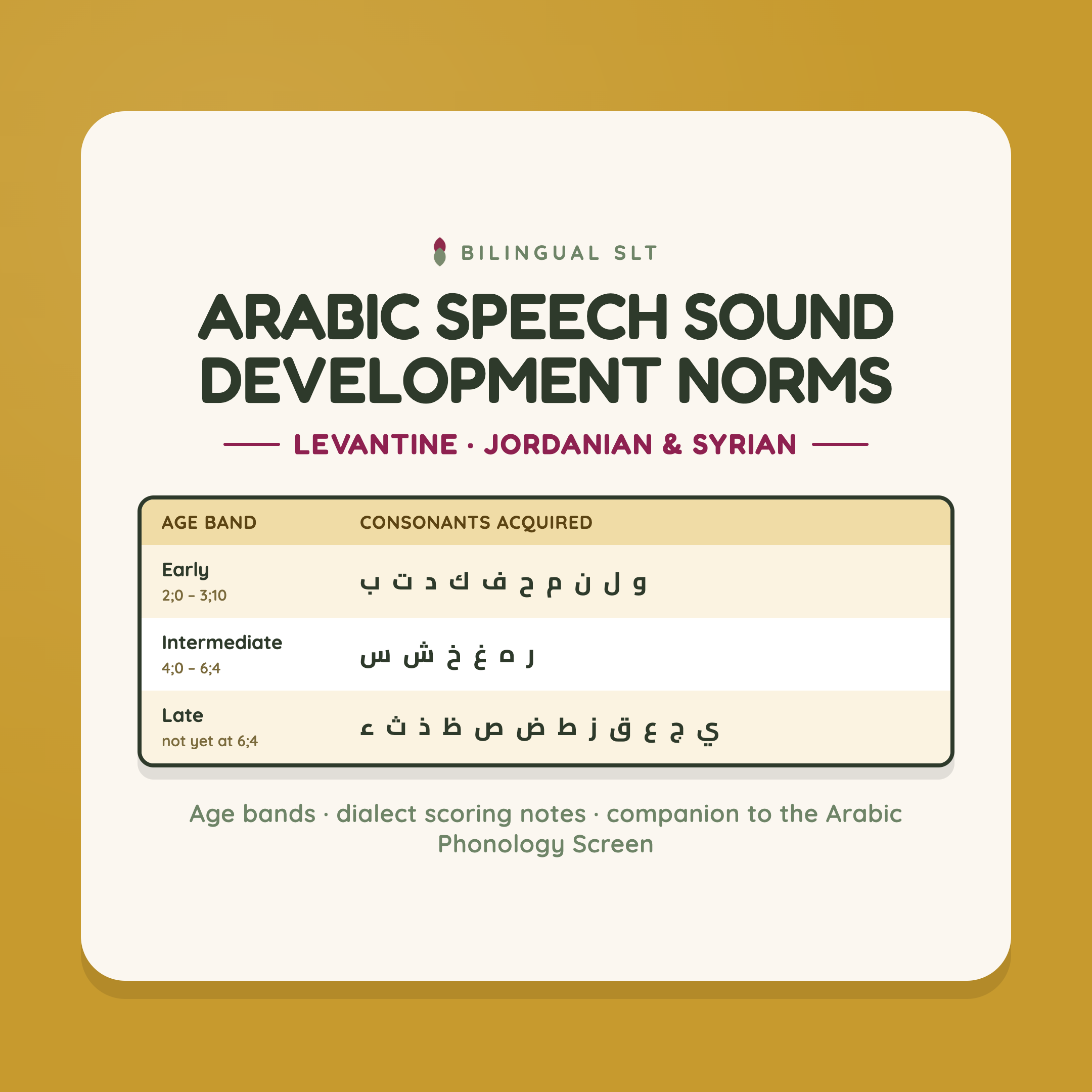
A 3-page companion reference for the Arabic Phonology Screen (APS), setting out consonant development ages for Jordanian and Syrian Arabic side by side.
What’s inside
The Jordanian consonant tier list (Amayreh & Dyson, 1998; Amman, n = 180): early, intermediate and late-acquired consonants, plus what happens to the late group between 6;6 and 8;4+ (Amayreh, 2003).
The Syrian age-band table (Owaida, 2015; Damascus, n = 160, 90% criterion), so you can see exactly where the two dialects’ published data agree and where the threshold used makes them look different.
A dialect-scoring table (Hamdan & Amayreh, 2007) showing that six consonants scored as “wrong” against the MSA target are correct 95–99% of the time once the child’s own Jordanian dialect form is accepted.
Phonological error pattern cut-offs for both dialects, and a note on where the two studies’ findings conflict and haven’t been resolved.
Why it matters
The Jordanian and Syrian studies used different acquisition thresholds (75% and 90%), so lining their ages up side by side without saying so makes Syrian children look slower than they are. This reference keeps each study’s criterion attached to its numbers, flags the one unresolved contradiction in the literature (guttural consonants in a 2024 Ammani study), and tells you plainly which dialect-appropriate substitutions are not speech errors.
Instant digital download – 3 pages, PDF format.
Companion resource. Designed to be used alongside the Arabic Phonology Screen (APS).